Here are some of my recently finished works that I just photographed. I've been working a great deal lately on my photography and it looks to be paying off!
Amaco's Tenmoku under Seaweed
The above piece is fired to cone 6 and is Laguna's misfire b-Mix clay. The ceramic piece was first dipped in Amaco's Tenmoku, then the piece had Amaco's Potters Choice Seaweed brushed on towards the top. I've really enjoyed this combo, as the below piece was also glazed with this combination.
I also very much enjoy how the Tenmoku accents the sodium silicate texture that was applied when I was throwing this piece of pottery.
First firing in my kiln to cone 6, 2300 degrees fahrenheit, was a success! I have been trying some new glazes at this temperature by Amaco, and I have to say the results were quite magnificent.
Jade Pear by Mark Barta
To the left is a pear shaped form glazed with two coats of Amaco's Lustrous Jade on the body form and two coats of Tenmoku. Where the glazes meet there was a nice variegated color that I will have to try on a larger scale.
Jasper Vase By Mark Barta
Another glaze I tried was Amaco's Ancient Jasper. I really like the way the glaze breaks over the edges of the form and creates another color. The glaze was applied with three coats of glaze and the results were great! The inside of the vase was glazed with Amaco's Seaweed glaze, it's a little hard to see from the picture, but the glaze flows very nicely downwards to create a sense of movement. The two glazes combined create a nice contrast between each other.
Jasper Cup by Mark Barta
The cup to the left is another example of Lustrous Jade over Tenmoku. On this cup, I created more of an overlap between the glazes and as you can see the variegation in color made for a nice effect.
Brackers hosted a Raku firing event this past weekend and I want to share the results!
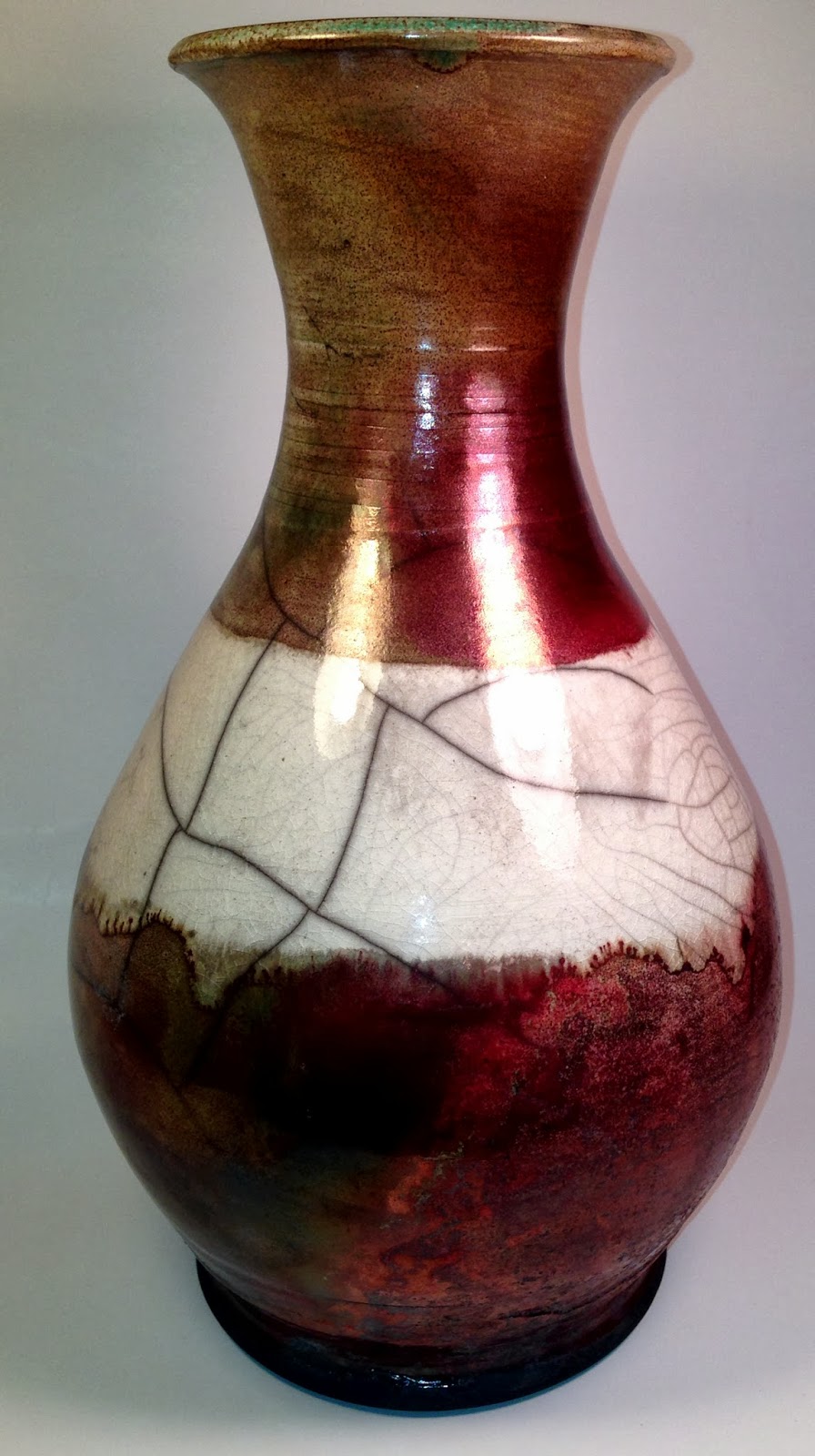
The first of two pieces that I raku fired is a 1 foot tall bottle form. When performing a raku firing, you superheat the piece of pottery to a couple thousand degrees, then while it is red hot and glowing you open the kiln and pick up the piece with tongs. Once you have a good grasp of the piece, you place the piece into a bin of combustible material and it instantly ignites into a fireball. While the fire is going, you place the lid on the bin to create a seal, all the oxygen is then burned out of the bin and the fire goes out, this creates a reduction environment. Once cooled, you pull the pot out of the bin and quench it in a water bath, solidifying the metallic results. As this was a rather large piece, you can imagine how nervous I was to drop the piece when it was molten hot and break it, but luckily all went well and I got a great piece out of it.
Another view of this piece is on the right.
The second piece of pottery I Raku fired was a platter. I especially like the teal tones that came out on the piece.
Blog number two, here we go. In todays blog I have decided to show some footage of me throwing. In this video I will be throwing a large bowl that can be both functional and decorative, I hope you enjoy!
In addition to today's video, I have also decided to update my blog more regularly. With the exception of this Sunday, I will still be showcasing new pieces of work on Sunday's and talking about the form and function, but I will be also now be posting a blog on Tuesday nights showcasing some throwing through a video on Youtube!
Above, is an example of a finished bowl I have made recently. When making bowls, many conscious decisions have to be made both during the actual throwing and the finishing (glazing). For example, in the video above, you will notice that much attention is paid towards the rim. As the rim is the main portion of the bowl that the intended user will touch, it is important for it to be smooth so that it will feel good when the user handles it. Also, like any piece, the rim of a bowl is a finishing point for a piece, so it is best to have a good finish point to end the profile.
Another conscious decision that must be made when designing a bowl is the glaze used. Whether the finished piece is supposed to be for functional or decorative from the potter's eye, one must remember that the buyer of the piece may use it for either. With that in mind, when glazing the bisque piece, I prefer to use glazes that are non-toxic and labeled dinnerware safe. This information can usually be located on the glaze bottle itself, if this information is not on the bottle, a quick check to the manufacturer's website usually will reveal this information. If in doubt, don't use it.